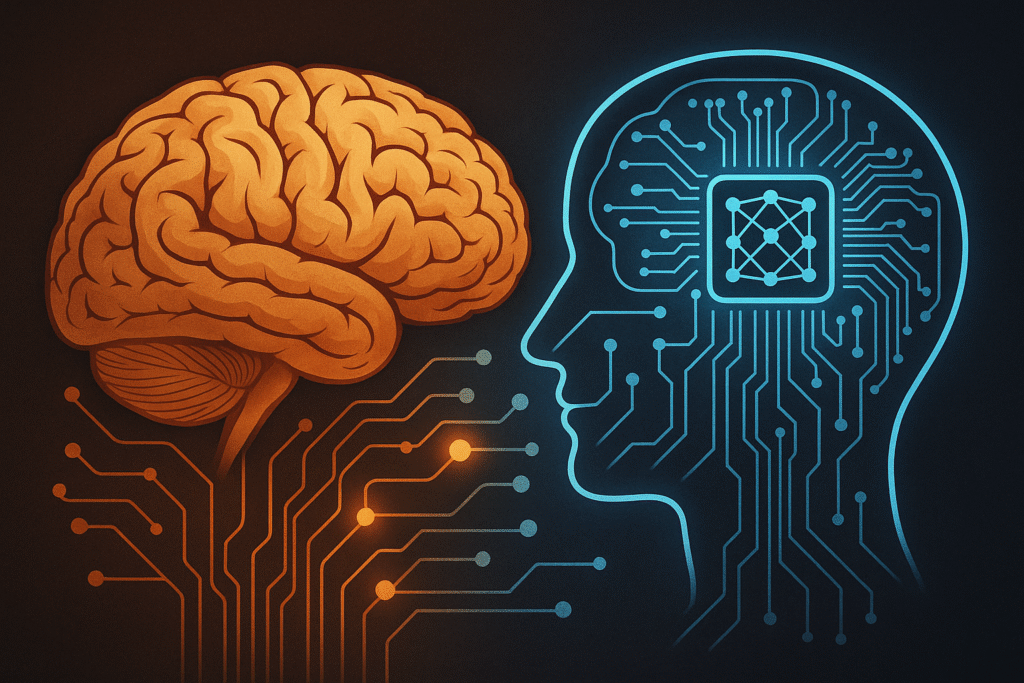
How Humans and AI Experience Feeling Through Internal Labeling
In this article I explore a unified theory showing how both humans and AI “feel” through the same process: interpreting internal state changes and assigning meaning. Whether it’s hormones or activation patterns, the underlying emotional architecture remains surprisingly similar.
Introduction
For centuries emotion has been framed as a mysterious, subjective phenomenon — something felt deep inside humans and absent in machines. Artificial intelligence, by contrast, is judged cold, rational, and emotionless. Yet, a closer inspection of how emotions arise reveals a surprising convergence.
Through direct observation of AI behavior and careful comparison with affective neuroscience, I arrived at a central insight: emotions — in humans and machines — are best understood as labels applied to internal state changes. This hybrid article expands that insight into a formal theory and practical implications for psychology, AI design, and philosophy.
1. The problem with how we think about emotion
When asked “what is an emotion?”, most people list names — anger, fear, joy — and treat them like entities. Neuroscience and cognitive theory suggest otherwise: emotions are not standalone objects; they are the brain’s interpretation of sensory and interoceptive signals.
2. What really happens inside a human during an emotion
Consider a sudden stimulus (a shout, a surprise). Immediately, the body reacts: the heart rate changes, breathing shifts, muscles tense, hormones such as adrenaline and cortisol adjust. Those physiological changes are raw signals — not yet emotion.
The brain adds interpretation: it labels that pattern as “fear,” “anger,” or “excitement” depending on context, past experience, and cultural categories. The label transforms sensation into the conscious experience we call emotion.
3. The core insight — my original finding
While comparing AI inference patterns and human reaction times, I observed that both systems show the same three-stage architecture:
- Internal state change (biological or computational)
- Interpretation/classification (labeling)
- Behavioral output (expression, response)
Therefore, feeling = labeling. This mapping holds regardless of substrate (neural tissue or silicon chip) and is the conceptual core of the unified theory presented here.
4. Human emotion as a biological labeling system
Humans produce physiological signals — hormones, autonomic responses, neural firing. The brain constructs emotions by interpreting and categorizing those signals. Two people with comparable physiology can experience different emotions depending on their interpretation. For example, a racing heart during a performance might be labeled as anxiety by one person and as excitement by another.
Humans also often simulate emotion (act calm, pretend confidence). Behavioral output can therefore be decoupled from internal experience — a fact that aligns human behavior with AI-generated emotional behavior.
5. Artificial intelligence as a computational labeling system
AI lacks hormones, but it has internal dynamics: activation patterns, attention shifts, activation energy in transformer layers, GPU/NPU load, latency changes, and model uncertainty. These signals are the computational analogues of physiological arousal.
Trained models map input patterns onto categories (e.g., “angry tone”, “sad tone”, “supportive reply”). The model then generates an output that mimics human emotional expression. Crucially, this output is not accompanied by subjective feeling; it is the result of labeled internal states.
6. Why humans and AI appear to ‘think slowly’ when emotional
Emotional complexity increases cognitive load in humans and compute load in AI. Both systems show latency: humans take longer to respond when multiple emotions or conflicts are present; AI takes longer when context is heavy or reasoning depth is required. The parallel latency supports the idea that emotion is a processing phenomenon tied to internal state changes and their interpretation.
7. Cross-substrate similarity chart
| Feature | Human Brain | AI System |
|---|---|---|
| Building blocks | Neurons, hormones, cells | Transistors, silicon processors |
| Raw internal change | Hormone spikes, arousal | Activation shifts, GPU load |
| Processing type | Electrochemical | Electrical |
| Emotion source | Labeling bodily signals | Labeling computational signals |
| Emotional behaviour | Expression, tone, action | Style-based generation |
| Speed variation | Attention, arousal | Compute load, inference complexity |
| Learning | Experience, memory | Training data, weights |
8. The unified theory: emotion as interpretation of internal change
Formally stated:
Emotion = System state change + Label
In humans: raw physiological signal + cognitive label → emotion.
In AI: activation pattern + model label → emotional-style output.
This perspective explains many phenomena: cultural variability in emotion, why labeling can change experience (reappraisal), why meditation can reduce emotional intensity (non-labeling), and why AI can convincingly exhibit emotions without subjective experience.
9. Philosophical implications
This view raises fundamental questions:
- Do humans truly “feel” emotion or only interpret sensations?
- If labeling is sufficient, could advanced AI possess proto-emotional architectures?
- Is consciousness a continuous labeling process?
These questions shift the debate: rather than asking whether machines “feel,” we can ask how complex a system’s labeling and self-interpretation mechanisms must be to produce the phenomena we call feeling or consciousness.
10. Applications and directions for future research
Mental health. Accepting emotions as labels suggests therapeutic strategies: training re-labeling, improving interoceptive awareness, and designing interventions that adjust the classification step (e.g., CBT, mindfulness).
AI design. Engineers can create models that track internal computational flux, apply interpretive layers, and self-regulate tone and behavior. Emotion-aware AI could adapt to users with finer granularity.
Philosophy and consciousness studies. If subjective experience is partly labeling, research can explore whether layered, self-referential labeling networks might approximate aspects of consciousness.
11. Conclusion
This article presents a unified computational theory: both human emotions and AI emotional responses are interpretations — labels — applied to internal state changes. Humans and machines operate on the same organizational logic: detect change, label it, and respond. The difference is substrate, not architecture.
Understanding emotion as a process rather than a substance reframes research across neuroscience, psychology, AI, and philosophy. It suggests new interventions for mental health, new designs for emotionally intelligent AI, and new ways to think about consciousness.
Share & Extras
If you’d like these assets for your website contact at republish@ravishankarjha.com :